Law-student portfolio project · Product + engineering
Argus
A working M&A drafting and review prototype I built to explore lawyer control: source-grounded analysis, inspectable redlines, and work product that can leave the interface.
Confidentiality obligations
The Receiving Party shall hold all Confidential Information in strict confidence
and shall use it solely for the evaluation of a possible transaction Permitted Purpose.
These obligations will survive for three years from the date of disclosure.
§1 · Trade-secret carve-outThe problem
Contract review is document-heavy and demands careful comparison against drafting guidance. Argus asks whether a retrieval pipeline can support a first pass — flagging potential issues, proposing missing provisions, and citing its sources — while leaving legal judgment with the reviewer.
What I built
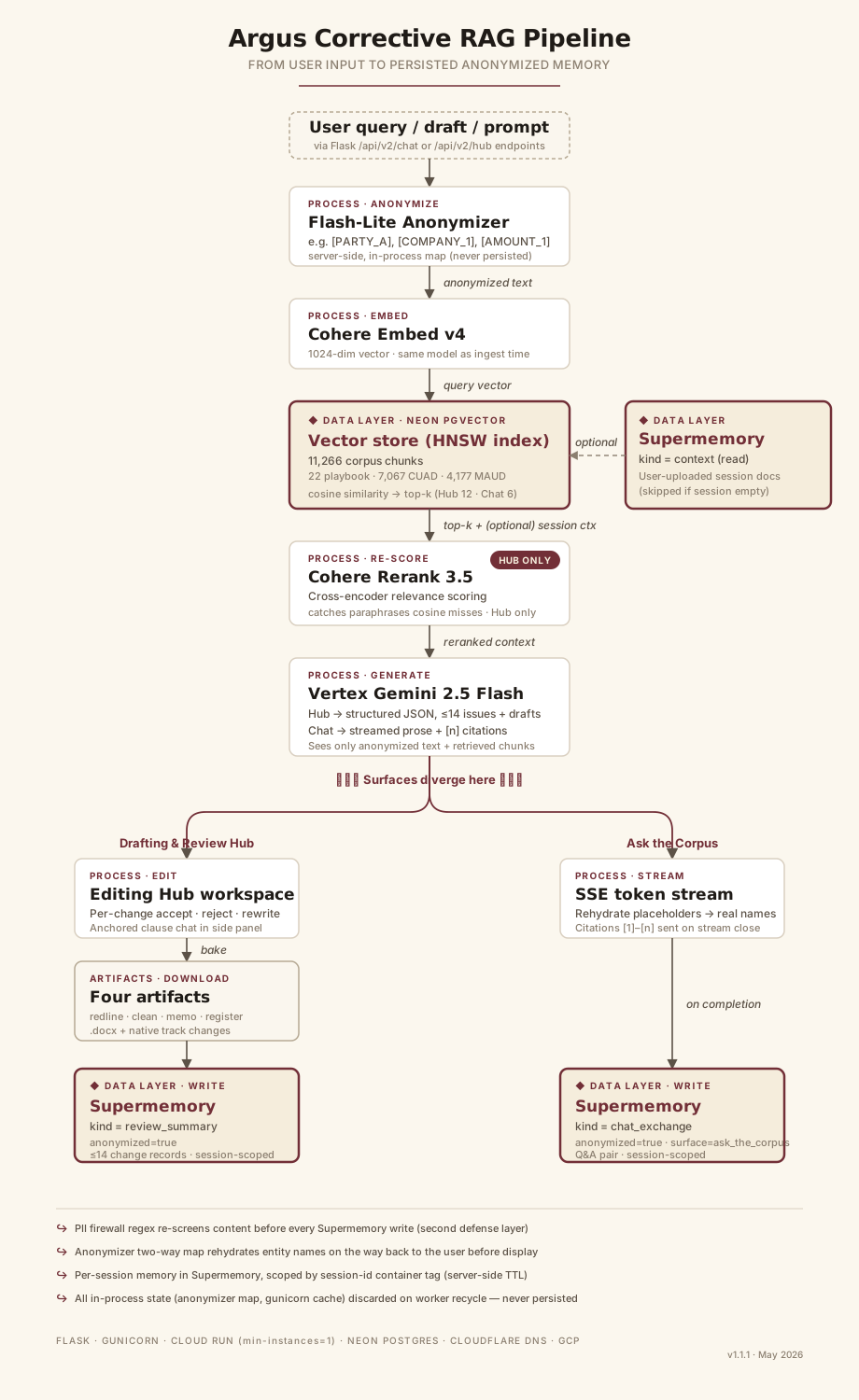
Argus has two surfaces. The Drafting & Review Hub is the main product: a two-pane editor where you can generate a contract from a prompt, revise an uploaded draft, or review an existing agreement — with per-clause accept/reject/edit controls, anchored chat, and four downloadable artifacts (redline.docx, clean.docx, memo.docx, register.json). The M&A Research Desk is a source-grounded research surface backed by 11,266 corpus chunks indexed in Neon pgvector: 22 playbook chunks across 12 categories plus ~7,067 spans from CUAD (the Contract Understanding Atticus Dataset, Hendrycks et al., NeurIPS 2021) and ~4,177 spans from MAUD (the Merger Agreement Understanding Dataset, Wang et al., NLLP @ EMNLP 2023).
Data handling depends on the selected path. Research and document-backed
Revise or Review requests attempt entity anonymization with Flash-Lite before
retrieval and generation. When that step succeeds, stable placeholders such as
PARTY_A and ORG_001 are maintained in a
per-session, in-process map and restored for display. The current prototype can
continue with the original text if the anonymization provider is unavailable,
so this is a risk-reduction measure rather than a confidentiality guarantee.
Generate without a document is a separate fast path: its prompt goes directly
to Gemini and skips anonymization and retrieval. Do not submit confidential or
identifying information through any path. A regex PII firewall re-screens
content before each Supermemory write on paths that persist memory.
Pipeline
Stack
Generation
- Vertex Gemini 2.5 Flash
- Gemini 2.5 Flash-Lite (anonymizer)
Retrieval
- Cohere Embed v4 (1024-dim)
- Cohere Rerank 3.5
- Neon pgvector (HNSW)
Memory
- Supermemory
- kind=chat_exchange / context / review_summary
- Session-scoped records screened by a regex PII firewall
Backend
- Flask + gunicorn
- Cloud Run (min-instances=1)
- Neon Postgres
Export
- python-docx
- docx-revisions (native <w:ins>/<w:del>)
Infra
- Google Cloud Platform
- Cloudflare DNS + Pages
- Secret Manager
What I learned
The hardest part was making the path-specific data flow explicit. When anonymization succeeds, Research and document-backed Revise or Review use a two-way pseudonym map that stays in process memory and is discarded when the worker recycles. The current fail-open fallback and the no-document Generate bypass are important limitations. A production version should fail closed before third-party calls or memory writes whenever anonymization is required.
The Hub reranks vector-search candidates with Cohere Rerank 3.5 before generation. I spent the most iteration time on that retrieval stage because its output directly shaped whether the spotter surfaced a specific drafting issue or a generic observation.
Validation matters more than I expected. v1.1.1 caught four silent failures
in the Supermemory write path that all happened to mask one another:
the standalone chat surface was missing the write code entirely; the PII
heuristic substring-matched "ein" inside common English words; the
Supermemory SDK changed its API surface (client.memories.add →
client.add); and the test prompt I used didn't reference enough
entity names to exercise rehydration. Each one looked like a deploy
problem until logs proved otherwise.